
What’s Changing With WCAG 3?
WCAG 3 is the next generation of accessibility guidelines being developed by the World Wide Web Consortium (W3C). It is expected to broaden the scope of existing accessibility guidance, introduce a different structure, and significantly change how accessibility conformance is measured and reported.
But there’s one thing website owners need to understand first: WCAG 3 isn’t finished yet.
The latest Working Draft was published on September 10, 2026, and W3C warns that its requirements and conformance model will continue to change. WCAG 2.2 therefore remains the standard website owners should work toward today. In fact, W3C says the best way to prepare for WCAG 3 is to meet WCAG 2.2 now.
So, what could eventually change?
What Are the W3C Accessibility Guidelines?
WCAG currently stands for Web Content Accessibility Guidelines. Developed through W3C’s Web Accessibility Initiative (WAI), the guidelines provide an international standard for making web content more accessible to people with disabilities.
WCAG addresses accessibility for people with disabilities including blindness and low vision, deafness and hearing loss, limited movement, speech disabilities, and cognitive and learning disabilities.
If terms such as WCAG, assistive technology, and digital accessibility are new to you, our guide to what A11y means is a useful starting point.
WCAG 3 even changes the name slightly. It will stand for W3C Accessibility Guidelines, reflecting ambitions to address more than conventional web content.
How Will WCAG 3 Differ From WCAG 2?
WCAG 3 isn’t simply WCAG 2.3 with a few additional requirements.
W3C says it will retain similar fundamental accessibility requirements while introducing a different structure, broader scope, and different conformance model.
1. A Broader Scope
WCAG 2 primarily addresses web content. WCAG 3 is being designed for web content, apps, tools, publishing, and emerging technologies.
The current draft discusses everything from conventional desktop and mobile content to streaming media, virtual and augmented reality, browsers, assistive technologies, content management systems, and testing tools.
That broader scope should make the guidelines more adaptable as digital experiences evolve.
2. A Different Structure
WCAG 2 organizes accessibility around principles, guidelines, and testable success criteria.
The current WCAG 3 structure includes:
- Guidelines: High-level accessibility outcomes.
- Core requirements: Requirements that must be met for conformance.
- Supplemental requirements: Additional accessibility requirements beyond core conformance.
- Assertions: Documented claims about accessibility-related procedures.
- Recommended practices: Additional practices that improve accessibility.
Supporting “Methods” will provide techniques, examples, resources, and tests for meeting requirements.
3. A New Approach to Conformance
This may be the most significant change for website owners.
WCAG 2 uses three conformance levels: A, AA, and AAA.
The September 2026 WCAG 3 draft proposes one conformance level, supported by reporting tiers that show progress below and beyond conformance.
Core requirements would receive tags based on their potential impact:
- Physical harm
- Risk
- Barrier
- Friction
The proposed system then uses six reporting tiers. Tier 1 starts with physical-harm and risk requirements. Tier 3 represents conformance because all core requirements have been met. Tiers 4 through 6 incorporate supplemental requirements and assertions beyond core conformance.
This model is still under review. W3C is actively asking for feedback on whether it improves upon earlier approaches.
Why Is WCAG 3 Changing?
The goal isn’t simply to reorganize the existing standard.
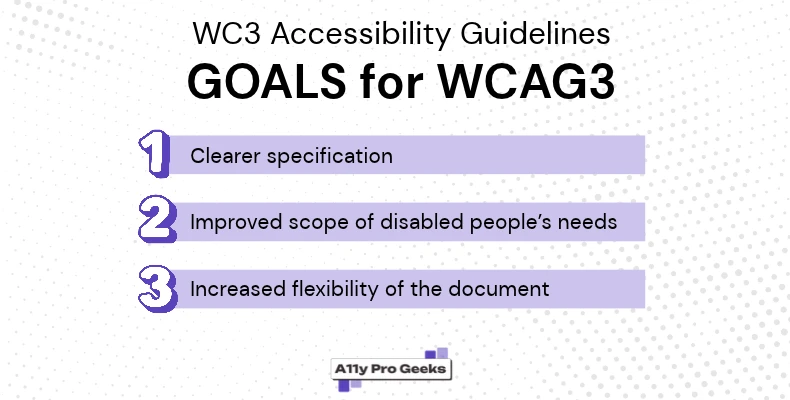
W3C says WCAG 3 is being designed to be easier to understand, address more user needs – including more needs of people with cognitive disabilities and work more flexibly across different technologies and organizations.
Another interesting development is the use of assertions.
An assertion is a documented claim that an organization followed an accessibility-related procedure. Examples could include accessibility training or usability testing. Assertions can’t replace core requirements, but the current proposal allows them to contribute to reporting above basic conformance.
That could encourage organizations to think about accessibility as an ongoing process rather than only a checklist.
What Should Website Owners Change Before WCAG 3?
For now, don’t rebuild your website around the WCAG 3 Working Draft.
W3C explicitly warns that requirements will be edited, added, combined, and removed before the standard is complete.
Instead, website owners can prepare by:
- Work toward WCAG 2.2 now. This is W3C’s own recommendation for preparing for WCAG 3.
- Fix fundamental accessibility barriers. Prioritize keyboard access, text alternatives, color contrast, forms, focus behavior, headings, navigation, and other established accessibility requirements.
- Test with people in mind. Automated accessibility testing is useful, but manual evaluation and appropriate assistive-technology testing can reveal barriers automated tools miss.
- Build accessibility into your workflow. Include accessibility during design, development, content creation, testing, and website maintenance.
- Keep records. Document audits, remediation, testing, training, and accessibility procedures. WCAG 3’s exploration of assertions makes organizational processes increasingly relevant.
You can find more practical guidance in the A11y Pro Geeks accessibility blog.
Do You Need to Comply With WCAG 3 Yet?
No. WCAG 3 is currently an incomplete Working Draft, not a finalized W3C Standard.
W3C says it is still several years from completion. It also expects WCAG 2 to remain in use for years after WCAG 3 is finalized rather than immediately becoming obsolete.
This distinction matters when discussing legal compliance, too. Don’t assume a draft WCAG 3 requirement is currently a legal obligation simply because it appears in the working document. Applicable accessibility laws and standards vary by jurisdiction.
The better approach is to maintain your website against current requirements while monitoring how WCAG 3 develops.
Why Keeping Up With WCAG 3 Matters
You don’t need to implement every proposal in the current draft, but you shouldn’t ignore WCAG 3 either.
Its direction gives website owners an early view of where accessibility standards may be heading: broader digital experiences, more user needs, different ways of documenting accessibility efforts, and a conformance model focused on the severity of barriers.
W3C published WCAG 3 drafts in March and September 2026 alone, demonstrating how actively the standard is evolving.
The practical takeaway is simple: don’t wait for WCAG 3 to start caring about accessibility.
Meeting WCAG 2.2, fixing real barriers, testing regularly, and integrating accessibility into your processes will put you in a much better position when WCAG 3 eventually becomes a standard.
Frequently Asked Questions
Not yet. WCAG 3 is still an incomplete Working Draft and is expected to take several more years to become a finalized W3C Standard. W3C also says WCAG 2 won’t immediately disappear when WCAG 3 is completed. For now, W3C specifically recommends meeting WCAG 2.2 as the best way to prepare.
WCAG 3 is being designed with a broader scope, different structure, and substantially different conformance model. The September 2026 proposal uses a single conformance level alongside reporting tiers rather than WCAG 2’s A, AA, and AAA model. However, this proposal is still being reviewed and could change before publication.
W3C hasn’t given a final publication date. Its current guidance says WCAG 3 is expected to become a W3C Standard in a few years, and the September 2026 draft states that several years of work remain. Website owners should therefore follow WCAG 2.2 rather than waiting for WCAG 3.
It isn’t appropriate to claim conformance with WCAG 3 as though it were a finalized standard. The current document is a Working Draft whose requirements and conformance model can change. Organizations can study and experiment with the draft, but current accessibility work should remain grounded in applicable standards such as WCAG 2.2.